It is a strange feeling to discover a book and immediately wonder how it took you so long to find it.
That was my first thought when I picked up Zamisli život: Novi Val – Prva Generacija by Dušan Vesić.
The title translates to “Imagine Life: New Wave – The First Generation.”
I looked at the publication date and realized it came out six years ago. Back then, I was convinced life was already pretty good.
I was wrong.
Life is significantly better now that I have read this book.
Dušan Vesić explores the rise of artists and bands from the Yugoslav new wave scene, and the strange combination of talent, obsession, timing, luck, and circumstance that shaped who became unforgettable.
There are four things I loved most while reading it.
So now I will share what I genuinely believe is the literary equivalent of David Attenborough quality storytelling: calm, fascinating, and full of the kind of details and strange little facts that make you stop reading just to appreciate how good the story is.
Spoilers from this point on.
1. Where artists start small is often exactly where they become unforgettable, and one of the things that struck me most about this book is how often these stories begin in the smallest, most ordinary ways.
For example, two of the first members of what would become the band Azra were simply neighbours in a modest village. Before Branimir Štulić became “Johnny Štulić,” he was just someone completely consumed by music. That intensity made him brilliant, but not always easy. By most accounts, he could be difficult, sharp, and impossible to ignore.
People couldn’t decide whether they loved him or hated him, which is usually a sign that someone is interesting (for better or worse, lol).
You can almost picture it: frontman Štulić, restless and electric, standing in front of a packed crowd at the Skenderija in Sarajevo.
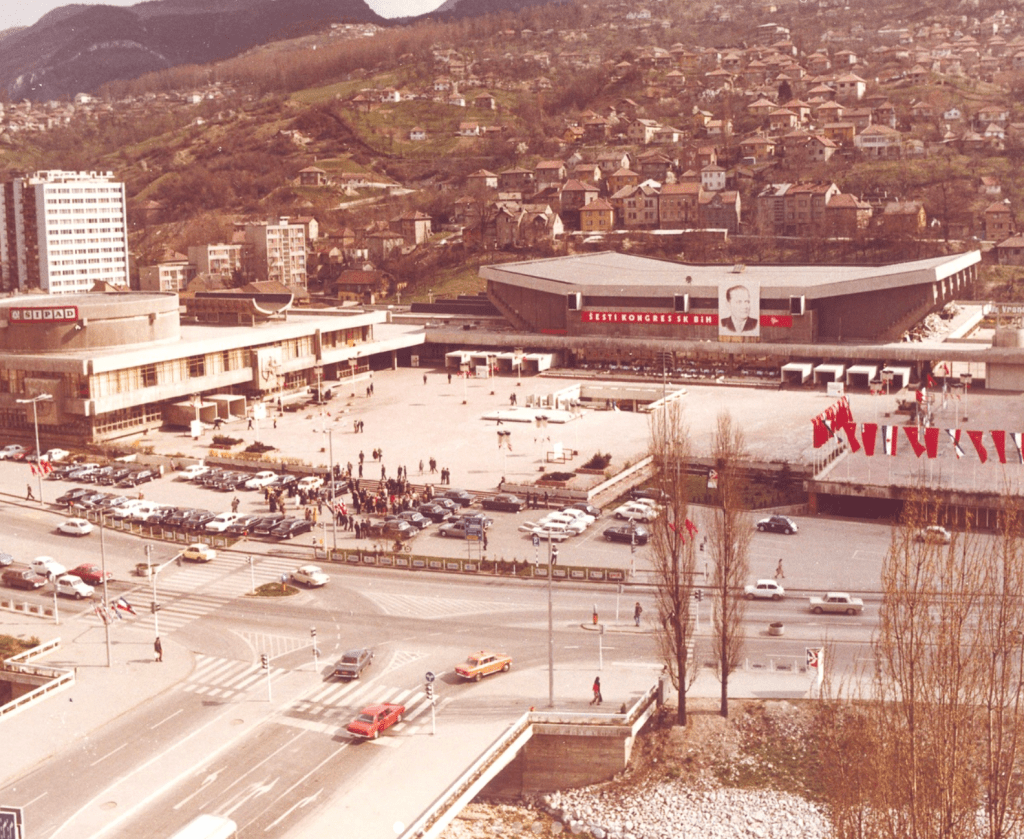
The book describes how Sarajevo’s Skenderija hosted massive outdoor concerts, not polished arenas but spaces that overflowed with people. Every square foot was taken. People stood on ledges, squeezed into corners, and climbed wherever they could just to catch a glimpse of the stage.
You can imagine Azra before becoming a household name, playing for a crowd that was there simply because they loved the music. Then, slowly, the rooms get bigger, the crowds get louder, and the band becomes something much larger than itself.
The Skenderija remains such a cool place for cultural events. I have included a photo from 1974, along with a more recent picture of the youth centre on the left side of it. Seeing both photos makes those concerts feel even more real, and it is easy to imagine the energy of that crowd filling every corner of the space.

2. When music left the radio and started walking beside people, it changed more than just how songs were heard; it changed how people experienced them.
This was the time when Walkmans were first being introduced, and music stopped being something you had to wait for and became something you could carry with you. It was no longer only about listening to the radio at home or going to concerts. People could choose what they wanted to listen to and make music part of their everyday life.
What also fascinated me was how physically close this entire music scene was. At one point, all the recording studios in Yugoslavia’s capital, Belgrade, were within about a 500 metre walking distance of each other. It makes the whole scene feel almost intimate, like everyone was constantly crossing paths, sharing ideas, borrowing energy from one another, and shaping music history on the same few streets.
At the same time, the music production side was still catching up to places like London and the broader British scene, where recording infrastructure was far more developed. Because of that, artists often looked elsewhere for recording major projects.
That is part of what makes Prljavo Kazalište recording Crno-bijeli svijet in just 53 hours so interesting. The album was actually recorded and mixed in Milan, Italy, which says a lot about where artists had to go to get the sound they wanted.
Even so, fifty-three hours to record and mix an album that would go on to become one of the most recognizable from that era still feels completely ridiculous! What made that even cooler to me was later discovering a 2015 television series called Crno-bijeli svijet, named after that same album. That part was not from the book, but finding it made the album feel even more alive, as if its influence had never really disappeared.
3. The quiet ways people show belief in each other can sometimes matter more than praise, and that is exactly what I kept thinking about while reading about Goran Bregović.
Most people know him through Bijelo Dugme or through the producing career in Poland that followed, but what stood out to me was how seriously he viewed artistic commitment. He respected people who were truly devoted to music, not just people chasing fame or attention.
One detail from the book I admired was about the band Piloti. Bregović’s father had been a pilot and died in a plane crash the same year Bregović was born. Years later, when the young band Piloti was still finding their identity, Bregović gave them his father’s original flight jackets from the 1940s.
He gave them to the band so they could create a recognizable identity, something people would remember them by. But more than that, just imagine the weight of giving something that personal to an upcoming band. It was not just a styling choice, it was a sign of belief. A way of saying: I take you seriously. I think you are worth it.
That kind of gesture says more than praise ever could, and it also explains why Bregović wanted to see “Johnny” Štulić perform for himself.
He had heard enough about this intense, difficult, magnetic figure and wanted to know if it was real.
But he did not want it to become a spectacle that Goran Bregović was attending an Azra concert. So he went in disguise, blending into the crowd at the Skenderija.
For someone like Bregović, that kind of curiosity says a lot on its own, and it leads into what I liked most about the book.
4. Why “Zamisli život” really does mean imagining life, is that you are reading about people decades before social media, before constant access, before you could follow artists and watch their lives unfold in real time.
Instead, you are piecing them together through stories written 3-4 decades later.
There is also something beautiful in how music history carries both celebration and memory.
The book’s title, which translates to “Imagine Life,” feels a little ironic to me. It makes me think about where so many of these artists, especially the new wave generation, might have gone if war had not arrived, and how much was paused, redirected, or lost entirely.
It reminds me that music history is never really just about music. It is about people, timing, and the strange ways ordinary moments turn into something lasting.
Books like this remind me why I care so much about these stories in the first place. One of the nicest parts is being able to talk about things like this with my family and friends, and to share something that feels both familiar and meaningful.
This book genuinely just made me really happy.
And honestly, if Zamisli život means “Imagine Life,” then this feels like a much better way to imagine mine than whatever I thought I was doing before I read it.
…
There were a few more things I wanted to share about this book, along with some other little stories that did not make it into this post, but I will save those for the next time I have some spare time to write a little more.
For now, I hope you enjoyed this!
